-
Day 1 Our representative will meet and greet you at Tribhuvan International Airport
Our representative will meet and greet you at Tribhuvan International Airport. Hotel transfer; Briefing about the Programme from our English Speaking Guide. Overnight. (30 minute drive, 1375 mtrs ).
-
Day 2 After breakfast –world heritage sightseeing tour
After breakfast –world heritage sightseeing tour in few major places in Kathmandu - Swoyambhunath, Boudhanath, Pashupatinath, and Kathmandu Durbar Square.Overnight at Hotel(5-6hrs, 1375 mtrs).
Pashupatinath Temple: The temple of Pashupatinath is a large double-roofed pagoda of brass and gilt; the gateway is plated with silver. It stands on the western bank of the Bagmati about five kilometer north-east of Kathmandu and contains the sacred Linga of Lord Shiva. Before the temple stands an enormous gift filigree of the bull Nandi, the mount of Shiva, flanked by a golden trident. There is a crematorium outside the temple by the side of the wide but shallow river and the wood surroundings are dotted with small shrines. On the occasion of the annual festival of Maha Shivaratri (February / March), the temple is visited by thousands of devotees including a large number of pilgrims from India. The temple is also the site of a number of other festival and ritual taking laces throughout the year.
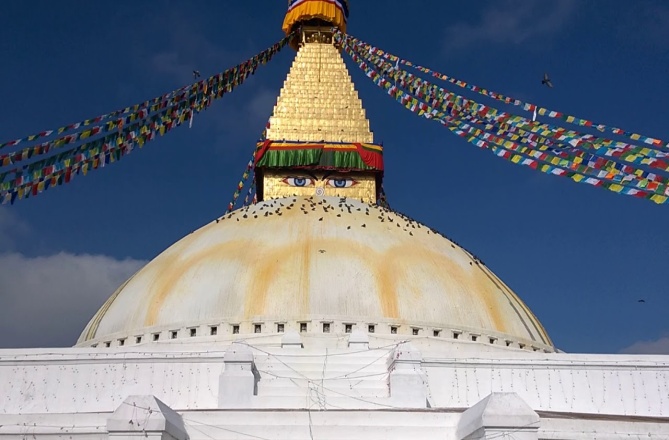
Bouddanath: This colossal stupa, one of the biggest in the world, is situated 2 kilometer north from Pashupatinath. The splendid some of Bouddhanath Stupa is approximately 120 ft. in diameter, 1hec in width and 43m in height. Its simplicity of form is its principal feature, unique among monumental stupas in the valley in its lack of the appended five shrines of the Buddha. Some consider it represents Adi-Buddha, the first or Primordial Buddha, free of conceptual emanations. Only the steps built into it on the north side, seemingly the ladder that Sakyamuni ascended into Tushita heaven, breaks its uniformity. A thick layer of whitewash coast the dome and the form of a bauble lotus depicted in saffron water colors it. This can be sponsored on various auspicious dates, and is also done annually on Dasain Purne occurring on the Full Moon in September by the Bouddhanath Area Development Committee. Bouddanath the dome, terrace with a remarkable 108 niches filed with stone sculptured deities of the Nyingmapa School's pantheon. They replace the usual five Buddha shrines in defining the content of the stupa-mandala; these images were almost certainly commissioned all at once by Sakya Zangpo in the 16th century, when the present stupa was built or thereafter. On the top of the Stupa, there are five symbols of Water, Ether, air, fire, earth.
Swyambhunath (Monkey Temple): 10 kilometer west from Bauddanath stupa. It is said to be two thousand years old, making it one of the world's oldest and glorious Buddhist chaityas. The Chaitys (Stupa) which forms the main structure is composed of a solid hemisphere of brick and earth supporting an ofty conical spire capped by pinnacle of gilt copper. Panted on the four-sided base of the spire are the al-seeing eyes of Lord Buddha. It is stand a hill as Stupa style.
Kathmandu Durbar Square: World Heritage Sites, UNESCO Basantapur Durbar Square is one of the famous sightseeing sports for the wood carving. A very old Hindu text has described Kathmandu as the land of gods surrounded by beautiful Hindu temples. Mainly trinity gods are found there like Brama, Vishnu and Shiva alongside Shakti temples. Kal Bhairav- one of the largest stone idols in Kathmandu representing the terrifying aspects of Shiva. Kal Bhairav is the god of the Justice in the ancient time. It means origin of the modern rules and regulation through Kal Bhairav. Similarly a Mahadev temple, Ganesh and Kumar temple, Kumari Ghar, Kasthamandap, Shiva Parvati temple, wood carving.Wood Carving is main attraction of Durbar Square.
-
Day 3 After breakfastsightseeing Patan and Bhaktapur drive to Nagarkot . 2100mtrs)
Patan: After having breakfast we drive to Patan city with city tour guide. It takes 30 minute drive from hotel. The ancient city Patan called Lalitpur which mean city of beauty. Here is planned on a circular format with Buddhist stupas at each of the four points of the compass. The city is three Km south east from Kathmandu across the Bagmati river. The city is full of Buddhist monuments and Hindu temples with fine bronze gateway, guardian deities and wonderful caving. Noted for its craftsmen and metal workers, it is also known as the city of artists. The city is believed to have been built during the reign of Vira Dev in A.D 299. Patan Durbar Square, Krishna temple, Hiranya Varna Mahavihar, Kumbeheshwar temple, Jagat Naryan temple, Mahabouddha Rudra Varna Mahavihar, Ashoka Stupas, Machhendranath Temple, Tibetan camp are main attraction of Patan City.
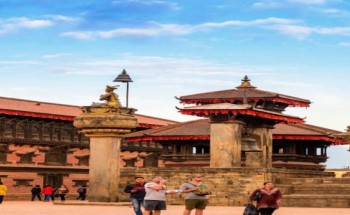
Bhaktapur: we drive to Bhaktapur where museum of medieval art and architecture with many fine examples of sculpture, woodcarving and colossal pagoda temples consecrated to different gods and goddesses. The city is shaped like a conch shell-one of the emblems of the god Vishnu and was founded by Kind Ananda Beva in A.D. 889. The city is 1402m above sea level. Pottery and weaving are its major traditional industries. The city is fifteen kilometer east from Patan. Sidda Pokhari (lake), Royal palace, The lion gate, The golden gate, The palace of Fifty Five Windows, The picture gallery, The statue of King Bhupatindra Malla, Bastala Temple, The Pashupati Tempe, Nyatapola Temple, Bhairab Nath Temple, Dattatraya Temple, Mayur Jhyal (Peacock windows) etc. are main attraction of Bhaktapur city. After having lunch we drive to Nagarkot .
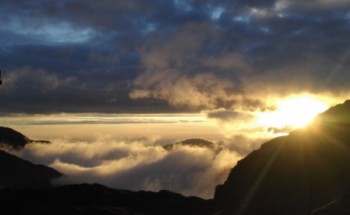
Nagarkot is 32 km NE of Kathmandu on the northern fringe of the Kathmandu Valley. Nagarkot is famous for its Himalayan views- the Himalayan peaks at sunrise are a magnificent sight to behold. Many wish upon arrival they would have planned for more than one day to stay. Nagarkot is surrounded by thickly forested hills of pine trees which give you an idyllic scene.
-
Day 4 After breakfast drive to Pokhara; hotel transfer, boating at Fewa Lake. Overnight.235kms (6-7 hr drive, 827 mtrs)
Pokhara: Pokhara is a remarkable place of natural beauty. Situated at an altitude of 827m from the sea level and 200km west of Kathmandu valley, the city is known as a center of adventure. This enchanting city has several beautiful lakes and offers stunning panoramic views of Himalayan peaks. The serenity of lakes and the magnificence of the Himalayas rising behind them create an ambience of peace and magic. So today the city has not only become the starting point for trekking and rafting but also a place to relax and enjoy the beauty of nature.
Fewa lake:Fewa Lake is a freshwater lake in Nepal located in the south of the Pokhara Valley that includes Pokhara city; parts of Sarangkot and Kaskikot. The lake is stream-fed but a dam regulates the water reserve, therefore, the lake is classified as semi-natural freshwater lake. It is the second largest lake in Nepal the largest in Gandaki Zone followed by Begnas Lake. It is the most popular and most visited lake of Nepal. It is the only one lake of Nepal which has temple at the centre part of lake, Natively called Barahi Mandir. Phewa lake is located at an altitude of 742 m (2,434 ft) and covers an area of about 5.23 km2 (2.0 sq mi). It has an average depth of about 8.6 m (28 ft) and a maximum depth of 24 m (79 ft).Maximum water capacity of the lake is approximately 43,000,000 cubic metres (35,000 acre·ft). The Annapurna range on the north is only about 28 km (linear distance) away from the lake. The lake is also famous for the reflection of mount Machhapuchhre and other mountain peaks of the Annapurna and Dhaulagiri ranges on its surface. The Taal Barahi Temple is situated on an island in the lake.Phewa lake and water sports is the main tourist attraction of Pokhara city and the north shore of the lake has developed into a tourist district, commonly called Lake-Side, with hotels, restaurants and bars catering to the tourists.
-
Day 5 After breakfast, Full day sightseeing of Pokhara
After breakfast, Full day sightseeing of Pokhara including, International Mountain Museum , Mahendra cave, Seti George ,Davis Fall, Gupteshower Madahav Cave. Ovenight (5-6 hrs, 827 mtrs)
International Mountain Museum: Mountains and mountaineering have a history of their own. Without preserving it, it will not be long before all the records and evidences will be lost forever. Nepal Mountaineering Association (NMA), established on 1 Nov 1973, initiated the establishment of International Mountain Museum (IMM) in Pokhara. The basic objective for its establishment was made to record, document and chronicle the past and present development of mountaineering activities in the world in general and to preserve the saga of the momentous feats in the history of mountaineering in the Himalayan peaks in particular. The foundation stone of IMM was laid on 1 Dec, 1995. The soft opening of IMM took place on 29 May, 2002 where it was officially opened on 5 Feb, 2004.
With an objective of maintaining systematic records of the successful eight thousands, geographic flora and fauna and human activities in the range, the International mountain Museum has been established at the foot step of fishtail peak and gate way to the mountain region. The shape of the museum roof itself resembles mountain skyline to any visitor before entering the museum main gate.
Mahendra Cave: Mahendra Cave is located close to the Seti River, is the large limestone cave. It is a rare example of a cave system in Nepal containing stalagmites and stalactites. The cave attracts thousands of tourists every year. A statue of Hindu lord Shiva can be found inside the cave. The place where Mahendra cave lies is full of greenery. The grazing horses and mules can frequently be observed in this area. This place lies in the bottom of a hill covered with greenery. Many surrounding hills full of greenery can be observed from here. Another great cave called Bat Cave can also be visited by travelling in the trail path just beneath the hills within ten minutes by foot.
Seti George: Flowing right through the city, the boisterous river runs completely underground at places. Amazingly, at certain points the river appears hardly two meters wide. But its depth is quite beyond imagination – over 20 meters! Mahendra Pul, a small bridge near the old Mission Hospital, provides a perfect view of the river’s dreadful rush and the deep gorge made by its powerful flow.
Davis Fall: The water forms an underground tunnel after reaching the bottom. This tunnel is approximately 500 feet (150 m) long and runs 100 feet (30 m) below ground level. On 31 July 1961, a Swiss couple Davi went swimming but the woman drowned in a pit because of the overflow. Her body was recovered 3 days later in river Phusre with great effort. Her father wished to name it "Davi's falls" after her. Its Nepali name is Patale Chango, which means "underworld waterfall".
Gupteshower Madahav Cave: Located in the south-east at Chhorepatan, Pokhara, the Gupteshwor Mahadev Cave is considered 599 years old. While the young local people went deeper, they found out that an idol-like object resembling Lord Shiva had formed naturally on the spot. Later on, it was taken to be Lord Shiva and the local people formally consecrated and installed it at the mouth of the cave in 1992. Gupteshwor Mahadev Cave is situated on the Pokhara-Tansen road. From the Lakeside and Damside, the cave is just a leisurely-walk away, but visitors can also hire a taxi, motorbike or bicycle to get to it. A micro bus service is also available from the city, which is a cheap and reliable form of transport.
-
Day 6 After breakfast drive back to Kathmandu .Evening visit tourist market Thamel.200kms/5-6hrs
After breakfast drive back to Kathmandu .Evening visit tourist market Thamel.200kms/5-6hrs
-
Day 7 After breakfast, ready for the final departure to your hometown with the lifetime memories of Kathmandu and its culture.
After breakfast, ready for the final departure to your hometown with the lifetime memories of Kathmandu and its culture.